Home
Products
Wet laser particle size analyzer
Dry laser particle size analyzer
Wet and dry integrated laser particle size analyzer
Nanoparticle Size and Zeta Potential Analyzer
Spray Laser Particle Size Analyzer
Online laser particle size analyzer
Image Granularity Analyzer
Zeta Potential Analyzer
Technology
Laser Particle Size Analyzer Related
Knowledge popularization related
Online Testing Research
Nano-testing related
Image Analysis Test Study
Service
Applied Research
Technical support
After-sales service
Video
Technical Explanation
Instrument Usage
Instrument Maintenance
About Us
Company Introduction
Honorary Qualifications
Corporate culture
Development History
Employee Highlights
Blog
Company News
Product Updates
Application Industry
Contact Us
Headquarters
Domestic Office
Foreign office
Professional manufacturer of intelligent analytical instruments
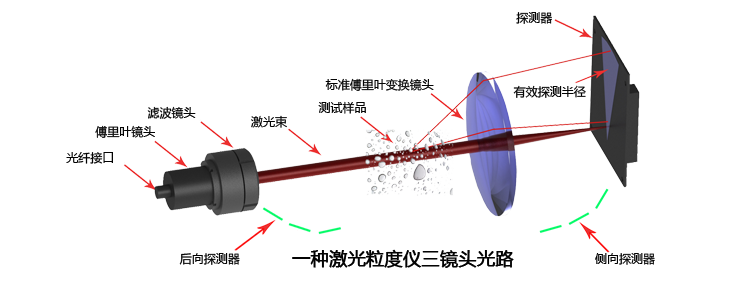
Three-lens optical system (patented technology)
The optical path is purer and the background level is lower, enhancing measurement accuracy and instrument sensitivity. The 110-mm large-aperture lens expands the detection angle, while the increased number of detectors improves resolution. The three-lens optical system comprises an imported high-power fiber-optic laser source, a patented Fourier lens, a filtering lens, a standard Fourier-transform lens, a forward detector, and a lateral detector. The fiber-optic interface connects to a high-power fiber laser; the Fourier lens transforms the diverging laser beam into a converging one. The filtering lens primarily eliminates scattered stray light, ensuring that the converged light on the optical path is even purer, thereby reducing the instrument’s background level and improving measurement accuracy and sensitivity. When a sample is illuminated by the laser beam, it generates scattered light signals. The standard Fourier-transform coated lens focuses these scattered signals onto the detector, resulting in a stronger and more sensitive detection signal.
Dual-lens optical system (patented technology)
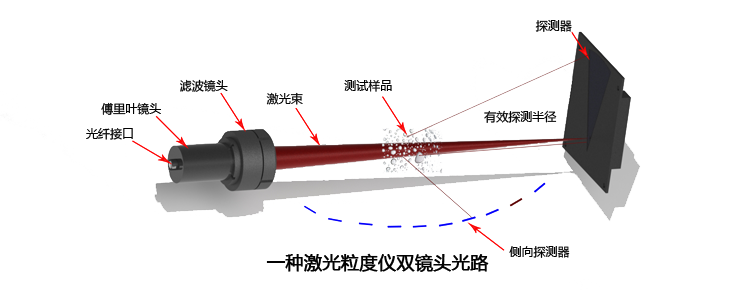
The dual-lens optical system consists of an imported high-power fiber-optic output laser, a patented Fourier lens, a filtering lens, a forward-facing detector, and a side-facing detector. The fiber optic interface connects to a high-power fiber laser; the Fourier lens transforms the scattered light from the laser into a focused beam. The filtering lens primarily eliminates stray light caused by off-axis dispersion, ensuring that the focused light on the optical path is purer, thereby reducing background noise and enhancing the instrument's measurement accuracy and sensitivity. When the sample under test is illuminated by the laser beam, it generates a scattered signal, resulting in a stronger and more sensitive detector signal. This significantly improves the instrument’s resolution and sensitivity, enhances measurement accuracy, and breaks through the limitations of acquisition speed.
Automatic Centering System (Patented Technology)
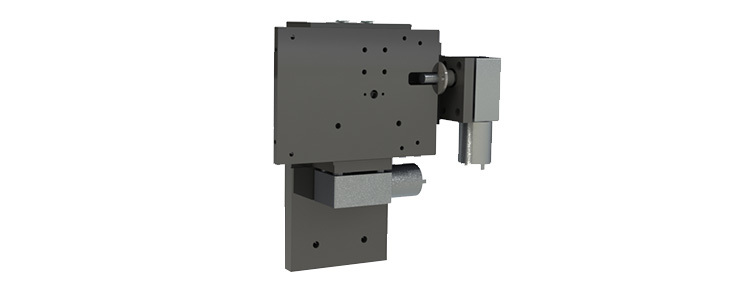
The dual-lens optical system consists of an imported high-power fiber-optic output laser, a patented Fourier lens, a filtering lens, a forward-facing detector, and a side-facing detector. The fiber optic interface connects to a high-power fiber laser; the Fourier lens transforms the scattered light from the laser into a focused beam. The filtering lens primarily eliminates stray light caused by off-axis scattering, ensuring that the focused light on the optical path is purer, thereby reducing background noise and enhancing the instrument's accuracy and sensitivity. When the sample under test is illuminated by the laser beam, it generates a scattered signal, resulting in a stronger and more sensitive detector signal. The optical path is automatically adjusted to keep the instrument’s optical system in perfect condition, guaranteeing both measurement accuracy and repeatability. After the instrument experiences vibration, its optical system quickly returns to its original position. This design simplifies the operator’s workflow and makes instrument maintenance easier.
Dry and Wet One-Button Fully Automatic Switching System
The optical path is automatically adjusted to ensure that the instrument’s optical system remains in perfect condition, guaranteeing the accuracy and repeatability of the tests. The NKT dry-and-wet dual-use instrument is fully equipped with one-button, fully automatic switching between dry and wet methods. After issuing a command, the instrument completes the dry-to-wet or wet-to-dry switch within 3 seconds and enters its optimal working state—unlike other brands’ dry-and-wet dual-use products that require manual switching, which not only increases operational intensity but also compromises instrument stability. Improper storage of the switched-off dry dispersion system or wet dispersion system may even pose a risk of damage. The instrument’s integrated dry-and-wet dispersion and sample-loading system has been ingeniously designed: whether operating in wet or dry mode, each system works fully automatically and independently. Both systems feature a design that ensures no residual samples remain after testing, and alternating between coarse and fine samples does not affect the test results.
96-channel simultaneous acquisition technology
Each particle size analyzer is equipped with a detector that has multiple independent channels to detect the scattered light from the sample. The scattered light signals are converted into electrical signals by the detectors and then analyzed by software to generate a particle size distribution spectrum. With advances in technology, in recent years, particle size analyzers have increasingly more optical channels—many models now feature as many as over a hundred channels. As for other brands' claims about the motherboard's sampling rate being so many times per second, each channel is sampled sequentially: only after the first channel has been fully sampled does the instrument move on to the second channel. Although it takes only a short time to complete the sampling of all over a hundred channels, the total sampling time remains quite long when compared to the constantly changing nature of the sample itself. As a result, the signals collected in this manner do not represent an instantaneous spectrum across all channels, and the resulting particle size distribution is therefore not highly accurate. NKT’s 96-channel simultaneous acquisition motherboard breaks through the limitation of sequential sampling. After the software issues the sampling command, all channels instantly freeze and collect data simultaneously—just like taking a photograph—to ensure temporal consistency of the spectra across all channels, thus delivering more accurate data.